
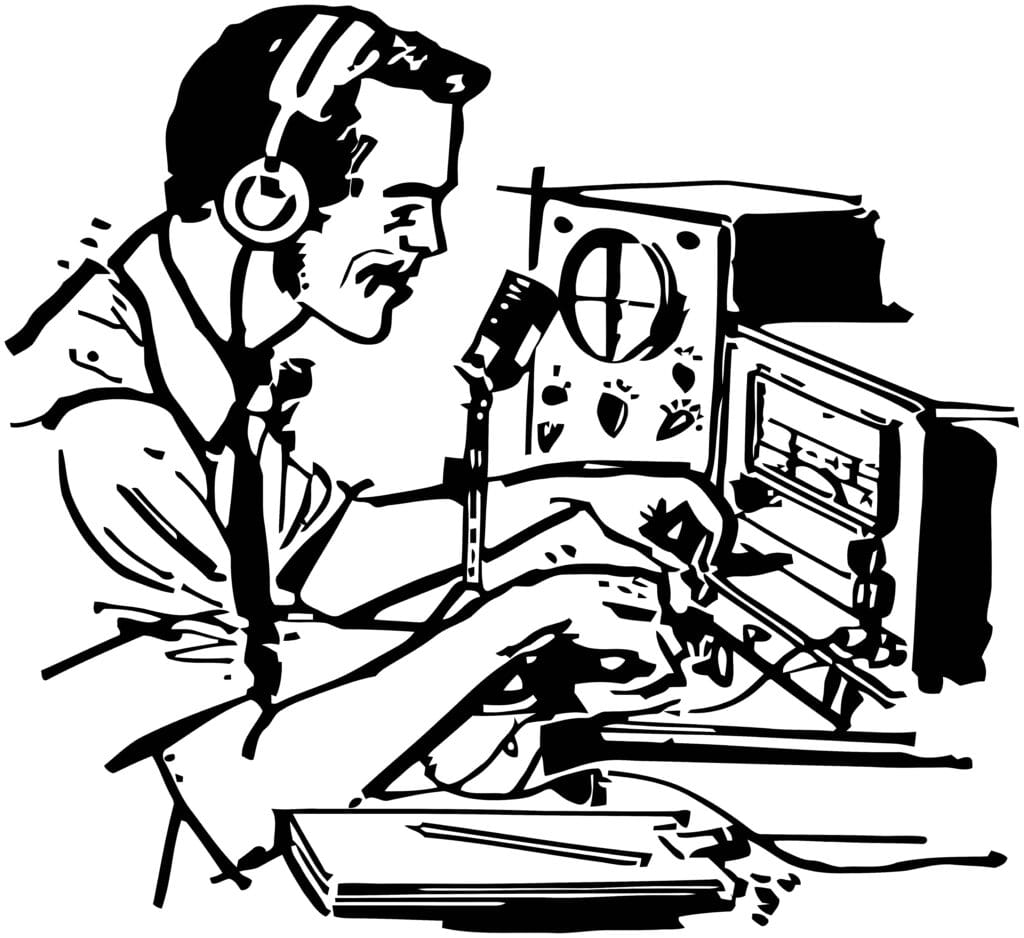
There is a particular thrill in hearing a voice come back to you out of the static for the first time. Mine came as M7RJJ, on a Foundation licence I had spent months working up the courage to use. More than five years later, I sit in the same shack (it’s also my work-from-home office) as M0LGI, and the journey between those two callsigns has been one of the most rewarding things I have ever done.
This is the story of how I got there, and a few honest reflections on what the path actually felt like.
It started with a curious child
My fascination with radio goes back further than I can properly remember. There is something almost magical about the idea that a voice, a song, or a Morse code character can travel hundreds or thousands of miles through nothing but air and ionosphere. As a child, I would tune through the shortwave bands on the family radio and listen to broadcasts from places I could barely find on a map. I did not know it then, but the seed was already planted. What I barely realised as a child was that ordinary people could actually do this themselves.
I also remember a visit to the local town show where the (now defunct, I think) Dudley and District Amateur Radio Society took over a ballroom at Himley Hall to house a ham station for the weekend. Everything was there from Analogue Fast Scan TV to the noisy RTTY teleprinters. I probably had a very glazed look on my face as I went round the room, listening to the chatter and ‘Donald Duck’ like noises of off-tune SSB.
The discovery that amateur radio was a thing, and that with a bit of study I could be on the air talking to those distant voices rather than just listening to them, lit a spark, but it would be many years before I could convince myself that I had both the time and technical literacy to do it.
I’m not from a scientific family. I’m from a council estate in Dudley. I was the first in my family to get any qualifications (seriously, I don’t think my parents, aunts and uncles have as much as an O Level between them) I’m also colourblind, so while I was always ok with things like code, circuits and resistors are largely impenetrable to me. I’m also a ‘words guy’ (politics degree).
My maths ability is poor, and it took me three attempts to get my GCSE. The only reason I persisted was that I needed it to get into university. Despite that, I decided, aged 38, that maybe I should find something to do now that I was married and had given up on ‘wine, women and song’.
Foundation Licence: the first hurdle
The Foundation licence is designed to be welcoming, and on paper it is. In practice, sitting down with the syllabus for the first time was still a moment of doubt. There were diagrams I did not understand, rules I had not encountered before, and an alphabet soup of terms that all seemed to mean something slightly different.
I got there with repetition. Lots of repetition. Flashcards became my best friend, and I drilled them on the train, in the kitchen, and in those quiet five minute gaps that turn up during a working day.
When the pass came through, and M7RJJ landed in my inbox, I held off transmitting for nearly a week. The first contact, when it finally happened, was a short and slightly stumbled exchange that I will never forget.
Intermediate Amateur Licence: the licence I cannot quite remember
Here is a confession that feels apt for a blog about memory. I cannot, for the life of me, recall my 2E0 callsign.
I held it. I used it. I made contacts with it. And somewhere in the move from Intermediate to Full it slipped out of my head and never came back. There is something quite funny about that, given how much of this whole journey has been about wrestling with a memory that does not always cooperate.
The Intermediate exam itself was a genuine step up. The maths started to bite, the regulations grew teeth, and the practical element forced me to actually solder rather than just nod along to a diagram. It took longer than Foundation, with more false starts and more evenings spent staring at a textbook or following a self guided online course, wondering why I had ever thought this was a good idea. But each small breakthrough felt earned, and that mattered.
The full amateur radio licence: the long climb
The Full Licence was where the journey nearly stalled. The syllabus is broader, the maths is much harder, and the volume of material to retain is genuinely demanding. For someone whose memory is, let us say, selective, this was the part of the path that demanded the most patience.
I gave up on cramming and went back to what had worked for Foundation level. Repetition. Flashcards. Little chunks, often. I would tackle one topic at a time, drill it until it stuck, then move on. When something refused to land, I would leave it and circle back a week later. Sometimes it had quietly taken root in the meantime. Sometimes it had not, and I would start again.
I studied with Bath and District Amateur Radio Club remotely. I can’t say enough good things about the syllabus and the quality of the teaching. But, I still had a false start, where I had to delay my entry and take the next course, due to feeling overloaded with the pressure from my then day-job.
The process took a solid five months from the initial assessment quiz (that I took on holiday in Greece) to the completion of the course. This was weekly 2 hour Zoom lessons and massive amounts of reading material and doing other online teaching modules and watching YouTube videos for more details, as well as building physical circuits.
The exam day itself was nerve wracking. It’s something you can do from home as long as you have an additional camera that can see you from behind and see under your desk. It was a Sunday morning in Mid-January and I had 2 hours to complete the exam.
I remember reading questions twice, then three times, convinced I was missing something. I got to the end, and the multiple-choice test was marked in an instant. When the pass came through, the feeling was not so much triumph as relief. M0LGI was issued a few days later, and a chapter that had taken more than five years finally closed.
The contact that made it all worth it
While the plan for the future is to operate overseas in France and Greece while staying with family (something you can’t do without the HAREC certification that comes free with a full amateur radio licence), the thing that made me think I was on the right course came early courtesy of my Xiegu G90.
Every operator has a contact that sticks with them. Mine happened while I was still M7RJJ, running the 10 watts that the Foundation licence then allowed. Ten watts is not very much. It is roughly the power of a dim light bulb, and the conventional wisdom is that you should not expect miracles from it on HF.
That afternoon I worked the ARRL Headquarters station in the United States. This is the US equivalent of working the UK’s National Radio Centre.
I still remember the moment my callsign came back across the Atlantic. Ten watts from a modest UK station, into the headquarters of American amateur radio. It was the sort of contact you read about in magazines and quietly assume happens to other people. The exchange was short, as contest exchanges always are, but the meaning of it was anything but small. A handful of watts had crossed an ocean. Every flashcard, every late evening with a textbook, every moment of doubt felt repaid in that one short exchange.
That is the thing about amateur radio. The reward is not the licence itself. The licence is just a door. The reward is everything that happens once you walk through it.
What I would tell my Foundation licenced self
If I could send a message back to the operator who first keyed up as M7RJJ, it would be short.
You are going to forget your Intermediate callsign. That is fine. You are going to find some exam topics harder than you expected. That is also fine. The journey is not a race, and the operators you meet on the air will not care how long it took you to get there. Take it at the pace your memory and your life will allow, lean on repetition when the material refuses to stick, and remember why you started.
A child once listened to voices coming out of the static and wondered how on earth they got there. More than five years of study answered the question. The answer is that you put in the hours, you trust the process, and one quiet evening, a signal finds your antenna and the whole thing makes sense.
73 from M0LGI, formerly M7RJJ, and briefly something with a 2 in it that I really should write down somewhere.
Leave a Reply